
How to take payments from students abroad
How a tutor takes payments from students in another country: why transfers fail, what a personal card risks, and how to get paid through a link instead of bank details.
Your student moved — the lessons stayed. Or the other way round: you moved, and half the group is still back home. The teaching goes on exactly as before, and then the money stops arriving: the transfer bounces, the student sends a screenshot of the decline, someone suggests «through a friend who lives there».
There are four cases really — you moved, the student moved, both of you did, or you run a school with students in several countries — and all four close the same way. Below: why money gets stuck at the border, what a personal card risks, and how this works on our side.
The short version: to take a payment from a student abroad, send them a payment link instead of your bank details. They open it in a browser and pay with the card they already use at home. You create one link per price, the money lands in your balance with the payment service, and from there it goes out to your card.
Why a payment from abroad does not go through
Everything familiar assumes you and the student are in the same country. The moment you are not, each route hits its own wall:
- Card to card — two minutes at home, a different operation across borders: a card can stop working abroad the moment its card network pulls out of the country that issued it, and cross-border transfers to it have nowhere left to run
- Domestic instant payments — domestic by design, tied to a phone number at a local bank, and a student banking abroad simply does not have one
- International wallets such as PayPal, Wise or Payoneer — accounts are closed for some nationalities and new ones are not opened. If you already live abroad with a local address they are usually available, but then currency rules of your own country come into play
- Money transfer operators — some corridors still work, but every operator has its own country list and it changes every few months: building a monthly routine on that means re-checking what works this month
- Card acquiring — your own needs a registered status and a review, and not every provider clears foreign cards reliably; international acquiring such as Stripe only works for people registered in a country it supports
Each of them works on its own terms — none of them answers the real thing. And what you are asking is simple: how does a person in another country pick up their own card and pay you for the lessons.
What a tutor risks by taking money on a personal card
Say a workaround turns up: the student hands cash to a friend, the friend transfers it to you. Or a relative pays with a local card. It works — right up to the first question from the bank.
There is nothing to panic about: the thresholds banks watch are far above a dozen lesson payments a month. But every bank also has models of its own, and regular, near-identical transfers from many different private individuals with no stated purpose are exactly the picture a human reviews by hand.
There is a mundane half too. Twelve transfers from people whose names do not match the names in your timetable — and you reconcile that by hand every month.
What a tutor actually needs: a link instead of bank details
Not a till, not acquiring, not a company in a third country. A link: you send it to the student, they open it in a browser and pay with their own card — the one in their pocket, in the country where they live.
Payment services do hand out such links, and a foreign card costs roughly the same across most of them — eight to ten per cent of the payment. Cheaper exists, but then look at the payout fee and at how often payments actually clear. The difference is not the percentage, it is what happens around the payment.
«Taking payments» is a tab in your account
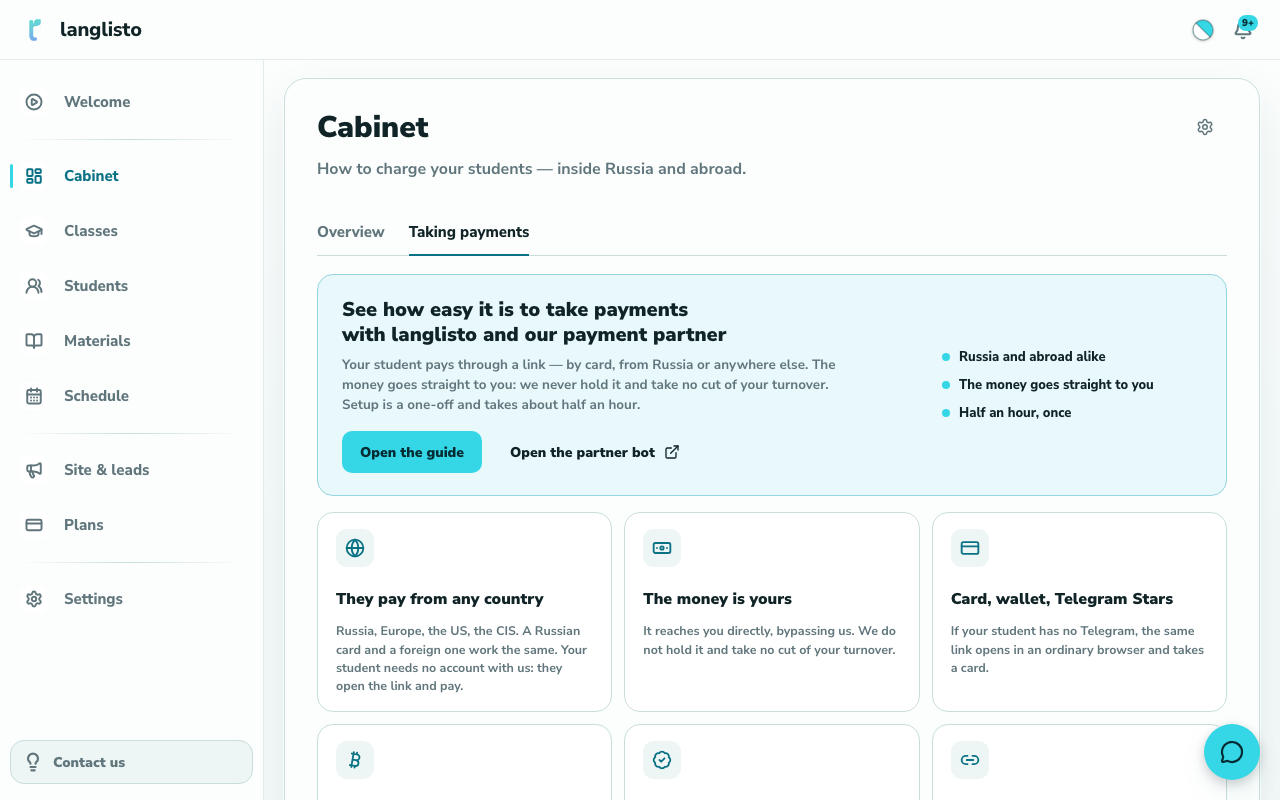
The «Taking payments» tab in «Cabinet» holds a guide: how to set collection up with a payment partner. Cards and payouts are handled by them — we have no checkout page, no invoices and no payment ledger. The money goes straight to you, past us, and we take no cut of your turnover.
How to set payments up: five steps
The guide opens right inside the tab: fourteen steps from an empty screen to money on your card, each with a screenshot and a caption telling you what to tap. It exists because the partner’s app is built for sellers, not for tutors, and half the steps there are not called what you would expect.
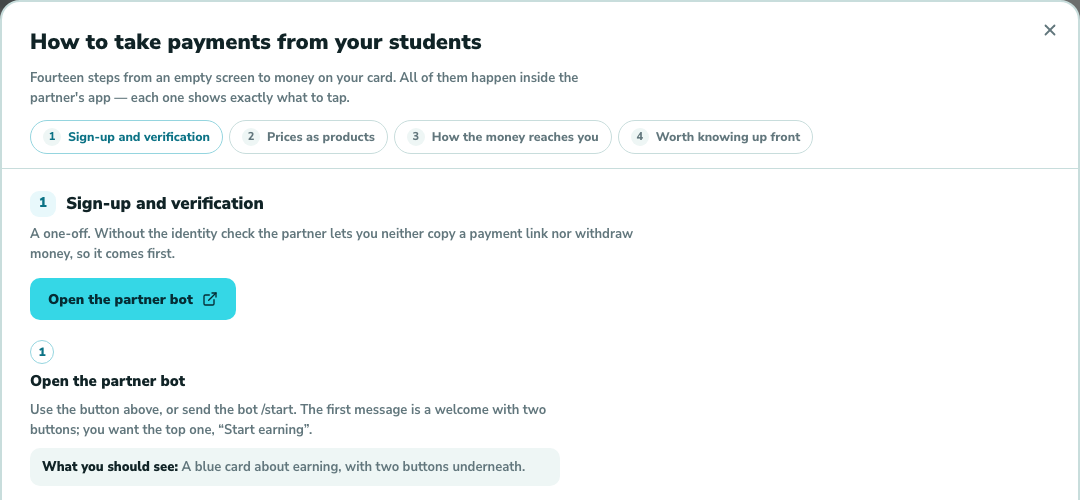
- Register with the payment partner
- Pass the identity check once
- Create your prices: a single lesson, a pack of five, a pack of ten
- Copy the link for each price
- Send the student the one they need
All of it happens inside the partner’s Telegram bot, so you will need Telegram — your student still will not. After that you never come back to the setup: a new link is only needed when a new price appears.
What the student sees, and what to write to them
You send the link yourself — into the class chat, a messenger, wherever suits. The student opens it in an ordinary browser, sees the name of the pack and the amount, and pays by card right there: no account with us required.
The answer to «so how do I pay you?» fits in one message: «Here is the link, open it in your browser and pay with your usual card — the one you pay with at home». Which cards clear in a given country is the partner’s side, so before handing the link to a whole group it is worth testing it once on a minimal amount.
How and when the money reaches you
A payment does not land on your card straight away: it builds up in your balance with the partner and leaves on a payout schedule. The partner’s terms as of August 2026:
- The standard fee is 10% of your amount, including domestic payments. New creators who register through our referral link in «Taking payments» get 0% commission on their first 30,000 ₽ of income. The service may also charge the buyer on top, so compare on the final sum rather than one number
- Currencies — roubles, euros or dollars: pick the one you price lessons in, and the student’s bank converts the amount on their card
- A single payment is capped: 100 ₽ to 100,000 ₽ in roubles, 1 to 1,000 in euros and dollars
- A payout leaves once the balance passes 3,000 ₽, 100 € or 100 USDT — automatically on the 10th and the 25th
- You can switch to payouts on request, no more than twice a month — but that turns the automatic ones off and you collect the money by hand
The money students pay is your income, and you account for it exactly as you did before. We are not part of that relationship — not a payment agent, and we hold no funds.
What to know before, not half an hour in
Five things people trip over on the first evening:
- Identity verification is mandatory and comes first: until it is done the partner will not even let you copy the payment link, so there is nothing to send
- One price, one link: the amount on an existing price cannot be edited, so create every price you actually use straight away
- Instant local payment methods are not something we promise — the partner offers them to some sellers only, and by separate request
- Refunds happen in the partner’s dashboard: the money goes past us, and we can neither refund a payment nor speed a payout up
- Thresholds, fees and the schedule are the partner’s terms and the partner may change them; check their rules before your first payout
How a language school takes payments from students abroad
Same scheme, only with several teachers. Each of them sets payments up on their own side, with their own prices, and the money reaches each of them directly — the school does not become a transit wallet and does not inherit anyone else’s refunds. The timetable, the classes, the materials and the access rights stay shared.
Why not just use a payment service and be done
The honest answer: you can get a payment link without us, the partner is open to everyone. Through our referral link, a new creator gets 0% commission on their first 30,000 ₽ of income. The guide is also written for tutors rather than for merchants: fourteen steps in the partner’s own order, screenshots from live screens, and the pitfalls flagged before you walk into them.
Then there is the everyday work. Payment is the last five per cent of working with a student; the other ninety-five is remembering who rescheduled, who never handed in the homework, where Thursday’s material is, and what to set the group after the holidays. A payment service knows none of that and never will.
Your account does: students, timetable, materials, homework and payments sit in one window. Nobody should move platforms for a payment link alone — but if you are already looking for somewhere to move from a notebook and a chat thread, payments from abroad get closed on the way. The first month costs nothing and needs no card.
Common questions
My student abroad cannot pay for the lesson — what do I do?
Send them a payment link instead of your bank details. They open it in a browser and pay with their own card, local or foreign, it makes no difference to the scheme. The link is created once per price: in langlisto that is the «Taking payments» tab, with the step-by-step guide in the same place.
What does it cost, and does the platform take a cut?
The platform takes nothing from your turnover — the money goes straight to you, past us. The payment partner’s standard fee is 10% of your amount. New creators who register through our referral link in «Taking payments» get 0% commission on their first 30,000 ₽ of income. The partner may charge the buyer on top. Your student needs no account with us to pay: the page opens in an ordinary browser.
When does the money actually reach my card?
Not on the day of payment. Amounts build up in your balance with the partner, and a payout leaves once it passes the threshold — 3,000 ₽, 100 € or 100 USDT — automatically on the 10th and the 25th. You can switch to payouts on request, but that turns the automatic ones off.
I moved abroad and my students stayed behind. Does this still work?
Yes, the mirror case makes no difference to the scheme: the student pays by link with their own card, the money lands in your balance with the partner, and you withdraw it to a card or a crypto wallet.
Do I need a contract or terms with a student in another country?
Formally you can teach without them, but a short set of terms settles half the future arguments: what a pack includes, how far ahead a lesson can be moved, what happens on a no-show. A payment link states none of that — you do.
Can my card be frozen because of transfers from students?
The thresholds banks watch sit far above a dozen payments a month. But banks run models of their own, and near-identical transfers from many different people with no stated purpose get reviewed by hand — which is why it is better to be paid as a service.
How does a language school take payments when there are several teachers?
Every teacher sets payments up on their own side and is paid directly — no shared wallet, and nobody else’s refunds land on the school. The school stays shared for the timetable, classes, materials and access rights.
How long does the setup take?
About half an hour, once, and a noticeable part of that is the partner’s identity check. After that you do not return to it: a new link is only needed when a new price appears.
Short version: taking payments across borders is not solved by hunting for a bank that still works, but by a link the student opens in their own browser. It takes about half an hour, once; the money goes straight to you, and the students, the timetable and the homework are already sitting next to it — which is what you were doing all this for.
we'll help you move your materials
